
An Afternoon with Rocky Sickmann: Surviving 444 Days
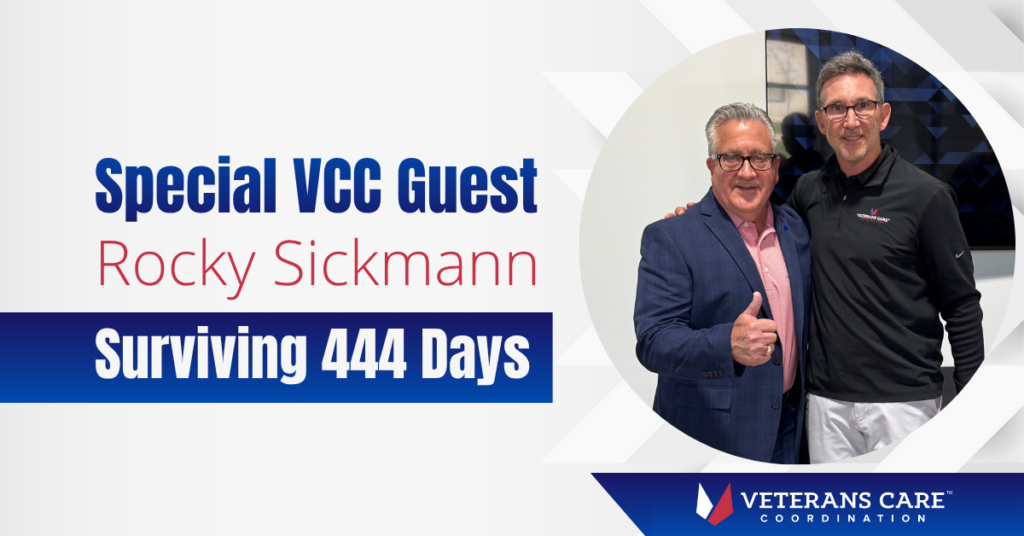
The Iran Hostage Crisis survivor shares a firsthand account of his 444 days in captivity during VCC’s 15th anniversary celebration.
On April 8, the Veterans Care Coordination team gathered to celebrate a milestone—15 years of helping Veterans and their families access the care and support they deserve. For many employees, it was a moment to reflect on the thousands of Veterans VCC has assisted over the years and the meaningful role each team member plays in that mission.
Adding to the significance of the day was the presence of special guest speaker Rocky Sickmann, a Marine and a survivor of the 1979 Iran Hostage Crisis. The event started with an introduction from VCC founder Kyle Laramie, who said, “We have had some great speakers over the years, but I am most excited about this one.” Kyle went on to explain that Sickmann has spoken internationally at prestigious events, including the PGA Championship and the Major League Baseball All-Star Game.
Kyle Laramie introducing Rocky Sickmann at VCC’s 15th anniversary.
Sickmann began by discussing his work with Folds of Honor, an organization that provides educational scholarships to the spouses and children of fallen or disabled service members and first responders. Since its inception in 2007, Folds of Honor has awarded over 73,000 scholarships, totaling more than $340 million, with 91 percent of every dollar donated going directly into the scholarship fund. Sickmann pointed out that 43 percent of the scholarship recipients are minorities, and 45 percent are female. Sickmann shared that this mission is particularly meaningful to him, as his own son was once a scholarship recipient.
Then Sickmann started to share the story that changed his life. As a picture of young Rocky in his USMC uniform appeared on the screen, he looked at it and joked, “My, how I have changed.”
Sickmann began by sharing about his family and their humble beginnings in Krakow, MO. He grew up with seven family members in a 900-square-foot house that his parents managed to make feel like “the Ritz Carlton.” Sickmann explained that his parents taught him many valuable lessons, but most importantly, they instilled in him three essential values: a love of family, a love of faith, and a love of country. He then said, “Little did I realize that these values would help me stay alive for a very long time.”
Kyle Laramie thanking Rocky Sickmann for being VCC’s guest speaker.
Sickmann wanted to become a Marine and dreamed of seeing the world. At just 22 years old, he was serving as a Marine Security Guard at the U.S. Embassy in Tehran, Iran. After only 28 days in Iran, militants stormed the embassy compound on the morning of November 4, 1979. Sickmann, along with 12 other Marines, was responsible for guarding the embassy, and all they had for weapons were a snub-nosed .38 and a sawed-off shotgun. Within hours, following orders to surrender from Washington, 60 individuals were taken hostage, marking the beginning of what would become 444 days of captivity.
As he explained the events that took place that day, the room grew quiet. Sickmann walked the audience through long periods of isolation, interrogation, and uncertainty. During the earliest days of captivity, Sickmann recounted being tied to a chair for weeks at a time, speaking only when questioned. At night, his wrists were tied to his ankles so he could not move while he slept. Personal belongings—including watches and rings—were taken. Time itself began to blur. Sickmann, 10,000 miles away from home, couldn’t get past this thought, stating, “The Vietnam War had just ended in 1975, and when they came home, they were spit on, and no one cared about them. Who is going to care about 60 Americans?”
Rocky Sickmann taking questions from the audience.
Sickmann expressed the loneliness he felt as he heard the world outside continue on every day. In response, he decided to follow a strict routine of push-ups and sit-ups during his captivity, concentrating on small daily goals and memories of home. At one point, he was instructed to wrestle an Olympic wrestler in his cell. During the match, he managed to throw the wrestler against a concrete wall, resulting in a crushed shoulder for the Olympian.
His story included a failed rescue attempt in April 1980—an operation known as Operation Eagle Claw, sometimes referred to as the Desert One mission—in which eight American servicemen lost their lives while attempting to bring the hostages home. Sickmann spoke with deep respect about those individuals, emphasizing that their sacrifice will always be part of the story.
Sickmann revealed, “You hear of people breaking in interrogations, it actually happened in this case. We had one person sing like a bird, and this was a military individual.” There was an American prisoner who betrayed them all by giving the Iranians all the information he could, and put seven individual prisoners into solitary confinement because of it, including Sickmann. He said, “I won’t mention his name and never will.”
One thing that remained with Sickmann was his memories. He recalled, “The one thing they could not take from me was the memories of growing up in a small town in Krakow, Missouri.” His memories were everything, and helped save his life. He remembered simple moments from his childhood: sleigh rides, football games, his mother’s cooking, and life at home. Those memories became a source of strength—something his captors could never take away, stating, “I had to go to my happy place for 444 days.”
Four hundred forty-four days.
More than 63 weeks.
One year, two months, and eighteen days.
It’s almost the amount of time it takes many people to earn an associate’s or master’s degree. A pregnancy only lasts 280 days. Yet for 444 days, Sickmann and his fellow hostages endured confinement, interrogation, and uncertainty about whether they would ever return home or if Americans even cared they were there. Little did he know there were yellow ribbons everywhere at home, Americans praying and showing support for all of the prisoners’ safe return.
The hostages were finally freed on January 20, 1981. Sickmann recalled stepping outside after months without proper shoes and hearing the crunch of fresh snow beneath his feet—a small moment that marked the beginning of freedom.
Yet even after recounting the hardships of those 444 days in captivity, Sickmann’s story carried an unmistakable sense of hope. His message was not one of bitterness; instead, it was one of resilience, perspective, and holding onto a promise he had made to himself—to return home and marry his girlfriend. He fulfilled that promise soon after his release. The couple has now been married for more than 45 years. Sickmann emphasized the meaning he has found in sharing his experiences and supporting organizations like Folds of Honor.
For the VCC team, the experience was more than hearing a historical account. It was a powerful reminder of why the company exists.
Every day, our employees work with Veterans whose lives were shaped by service, sacrifice, and moments most people will never fully understand. Hearing Sickmann’s story placed that work into an even deeper perspective.
Every Veteran’s story is courage, endurance, and a lifetime of experiences. And it reinforced something the VCC team already knows well: The heroes they help every day have lived through extraordinary chapters of history—and supporting them is a responsibility worth celebrating.
After speaking, Sickmann spent time walking through the room, talking with employees, asking questions, and listening to stories about their own connections to military service. Friendly, approachable, and quick with humor, he made an immediate impression. He was someone you instantly liked—humble, engaging, and genuinely interested in the people around him.
Sickmann stated that he will continue to share his story, describing it as both meaningful and therapeutic. He sees it as a way to honor the sacrifices made by others. For VCC employees, this experience reinforced a belief already well understood that the heroes they assist every day have lived through extraordinary chapters of history, and supporting them is a responsibility worth celebrating.
Click here to learn more about or donate to Folds of Honor.
