
Rudy Escobar: Veteran of the Month | March 2026
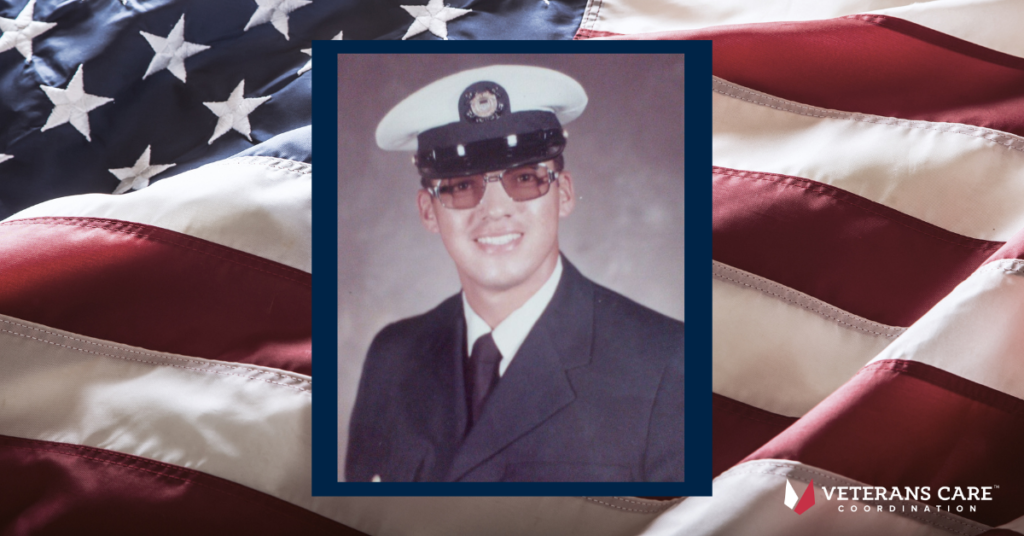 Rudy Escobar was born in Selma, California, near Fresno, at the Selma Sanitarium—a detail he enjoys sharing because of the reactions he often gets. Growing up in a large family, Rudy is one of six children—four boys and two girls. He is the third child and second son in the family. With a significant age gap between his older and younger siblings, he recalls how household rules changed over time, especially for the youngest children. He and his siblings were raised in Fresno and he lived there until he joined the military.
Escobar graduated from Fresno High School in 1971 during the Vietnam draft. Realizing he had a high draft lottery number and would need to maintain a full college course load to keep his deferment, he spoke with a friend about the Coast Guard. The Coast Guard appealed to him because of his love for the ocean, swimming, and scuba diving.
Escobar enlisted and served four years in the United States Coast Guard, a time he often humorously describes as “a four-year vacation.” He noted that the Coast Guard offered a different experience compared to many other branches of the military at that time, and he genuinely enjoyed his service. Escobar described, “It’s definitely military, but it’s just the smallest one of all the branches, but it was a lot of fun. It really was.” Due to his age and grade point average, Escobar qualified to attend the Coast Guard Academy but ultimately chose to enlist instead. Looking back, he sometimes thinks that attending the academy could have led to a career as an officer and a lifelong pension, but he has no regrets about the path he took.
Escobar believed he could learn whatever the service required. The structure of the Coast Guard meant that service members often had to handle multiple responsibilities. Because it is a smaller branch, personnel are expected to be multi-rated across different jobs. Escobar recalls performing a variety of duties, including basic tasks as a hospital corpsman.
Escobar completed boot camp at Alameda on Government Island, now known as Coast Guard Island, in Oakland, California. At the time, this facility served as a West Coast training center. It closed down as a recruit training center in 1982, leaving Cape May, New Jersey, as the Coast Guard’s primary boot camp.
During the eight-week training program, Escobar said one of the most important lessons was the value of teamwork. Escobar stated, “What I learned at boot camp reinforced what I learned in books when it came to old things like teamwork and what you can accomplish when you work together.” He and his fellow recruits quickly realized that helping the weaker members of their group allowed everyone to succeed more quickly. This reinforced the idea that a team is only as strong as its weakest link, and it helped them achieve top marks in two weeks, a feat that usually takes four to six weeks to accomplish.
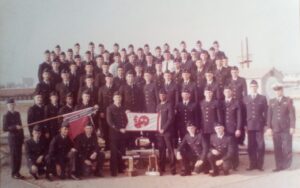
Rudy Escobar with his fellow recruits after completing boot camp, 1974.
Escobar’s first duty station after boot camp was in Hawaii, on the island of Oahu, close to the downtown area. He spent a year there before being assigned to an isolated duty station for a year-long deployment on Iwo Jima. Escobar explained, “I thought I was not going to like what they call an isolated duty station, which is where there are just a few Coast Guard personnel, no village, no women, no stores—nothing—just an airstrip. But it turned out to be the best year of my life.”
After spending a year stationed in Hawaii, he was sent to the remote island to serve at a Loran station—Long Range Aid to Navigation—a system that predated GPS. The station transmitted signals that enabled ships and aircraft to determine their positions within roughly 50 feet over large portions of the Pacific Ocean. The master station on Iwo Jima worked in coordination with several “slave stations” located in Hokkaido, Marcus Island, and Gashi, near Okinawa. Together, they operated using hyperbolic navigation to pinpoint positions across vast distances.
Escobar loved his time on Iwo Jima because the isolated environment gave him time to focus on personal growth. He spent much of his free time reading, playing chess, and staying physically active. He also explored the island’s historical sites, including Bloody Gulch, where Japanese and U.S. Marines fought in intense hand-to-hand combat during World War II. While exploring some of the tunnels built during the war, he discovered remnants of the past, including old ammunition. On one occasion, when he came across human bones, he immediately reported the discovery to the Japanese authorities. Escobar recalled, “You knew not to touch them. I had to report it to the captain there on base, and then they would have me show them where they were, and then they (Japanese authorities) very carefully examine and remove the bones and everything.” Escobar described his visits to the battle sites on the island as deeply spiritual experiences.
Although many people associate the Coast Guard primarily with Search and Rescue missions, Escobar explained that the branch performs a wide range of responsibilities. One of these is Aids to Navigation (ATON), which includes maintaining the buoys and markers that guide ships safely through waterways. He also noted the Coast Guard’s involvement during the Vietnam War, particularly in the Mekong Delta, where patrol operations resulted in the highest number of deaths per capita among the military branches.
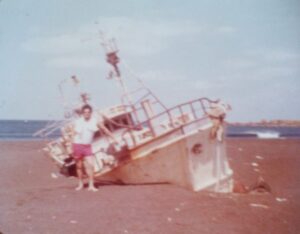
Rudy Escobar standing next to a shipwreck on Iwo Jima, 1975.
Escobar also appreciates the Coast Guard’s long history. He explained that the service traces its origins back to before the United States officially became a nation, when early maritime forces pursued ships carrying contraband such as Canadian whiskey. These early vessels, known as cutters, eventually evolved into what is now the U.S. Coast Guard. Over time, the branch has moved between several government departments, beginning under the Treasury Department, later the Department of Transportation, and today under the Department of Homeland Security. Escobar also noted the Coast Guard’s global presence, including its icebreaking missions and its distinction as the only U.S. service branch historically permitted to wear its uniform in Russia.
After completing his two years of service at the academy, Escobar was discharged in New London, Connecticut, and returned to California, where he used his GI Bill to attend Fresno State. He studied liberal arts and philosophy and earned his degree. His career path eventually took him into several different industries. For about ten years, he worked for a friend in the fire extinguisher business, which required him to study the equipment and pass a state licensing test to become certified in California. Later, he worked for a cousin who owned a food manufacturing facility, where Escobar served as the plant foreman and supervisor. In that role, he oversaw daily operations and ensured the plant maintained strict standards for food safety and cleanliness.
Escobar decided to retire early at age 62 after carefully reviewing his financial options. He found that waiting another ten years would only increase his retirement income by about $100 per year, making early retirement the more sensible choice. Since then, he has focused on spending time with family and enjoying a steady routine.
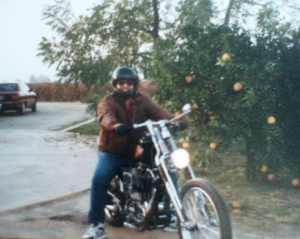
Rudy Escobar on his Harley, 1979.
Family remains an important part of Escobar’s life. Every Sunday evening, relatives gather for a large family dinner that can include anywhere from 15 to 50 people. He also attends church weekly and enjoys going to the movies every Tuesday, when first-run films are offered at a lower price. Escobar takes pride in his extended family’s accomplishments and values the emphasis they place on education and personal success.
Escobar has spent the past 30 years with his girlfriend, Denise. Although they live only five to ten minutes apart and see each other daily, they have never married. He humorously comments on the age difference between them, noting that people occasionally mistake Denise for his daughter or even his granddaughter. He laughs and says, “What do I look like? Am I that old? She just looks young; she has good genes.”
Today, Escobar describes his life as simple and steady. He does not drink or smoke and believes that staying mentally engaged enhances enjoyment in life. He recently celebrated his 73rd birthday on February 7, enjoying a month-long celebration that included a trip to the coast with Dennis, who celebrates a birthday in January. While he humorously calls his routine “boring,” his days are filled with family, community involvement, church services, and strong connections with those around him.
Veterans Care Coordination is proud to recognize Rudy Escobar for his service to our country. We are privileged to have the opportunity to share the stories of our nation’s heroes. Thank you for your service, Rudy, and welcome home.
