
Jeff Wideman: Veteran of the Month | April 2026
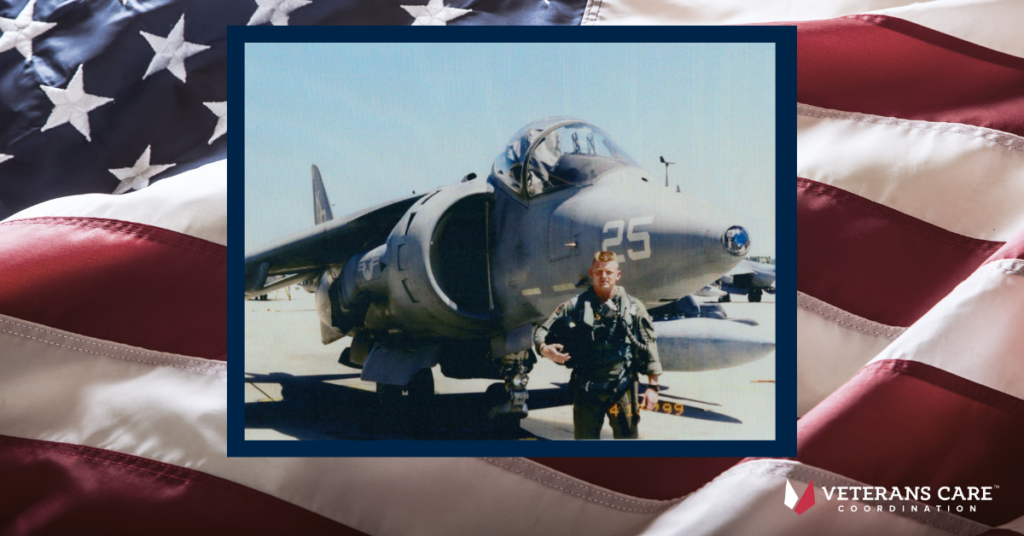 Jeff Wideman’s path to a 25-year military career began in St. Louis, Missouri, where he was born in April 1972. He grew up in Florissant and later graduated from Oakville High School in 1991. He was the younger of two boys in the household. As a kid, Wideman loved the outdoors. He loved playing football and hockey, and taking camping trips with his family.
During high school, Wideman confessed, “I was not stellar in school.” He struggled with his classes and was uncertain whether college was the right path for him. A counselor suggested that he consider a trade, but he had always been drawn to the military. Like many boys in the eighties, he developed an interest in becoming a pilot after watching Top Gun.
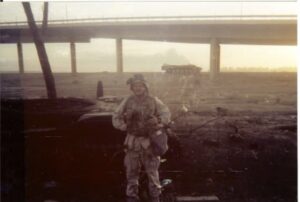
Wideman, 2003 in Baghdad during the invasion of Iraq.
In 1989, while still in high school, he enlisted in the U.S. Army. Through the delayed entry program, he attended boot camp during the summer before his senior year. The following summer, after graduating, he completed Advanced Individual Training (AIT) for his military occupational specialty (MOS) at Fort Leonard Wood.
During his service in the Army, he applied to become a pilot after being assigned to a Black Hawk unit at Scott Air Force Base. However, due to military cutbacks at that time, the number of flight school positions was significantly reduced, particularly for reservists. As a result, only active duty personnel were sent to flight school.
Wideman decided to head to college and began his education at Southeast Missouri State University but soon transferred to Central Missouri State University, which offered an aviation degree program.
During his sophomore year at Central Missouri State, Wideman met a Marine Corps Officer Selection Officer (OSO) who was recruiting candidates for pilot positions. After successfully passing the necessary tests and meeting physical qualifications, he received a conditional release from the Army. This arrangement allowed him to pursue a commission in the Marine Corps while still being obligated to return to the Army if he did not complete the process. Wideman explained, “When you are accepted into Officer Candidate School for the Marine Corps, you are not officially a Marine until you complete the course and raise your right hand.”
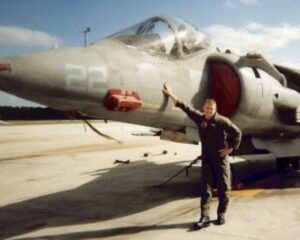
Wideman with a Harrier after just completing his Harrier training.
Wideman attended the Marine Corps Platoon Leaders Class (PLC) program in Quantico, Virginia, completing a six-week junior session in 1993 and a six-week senior session the following summer. After graduating from Central Missouri State, he was commissioned as a Marine Corps officer on campus. Soon after, he reported to The Basic School (TBS) in Quantico, where he began in late 1995 and graduated in May 1996.
Because he had a flight contract, Wideman already knew he would move on to aviation training. He reported to Pensacola, Florida, for primary flight training, flying the T-34 Mentor with Training Squadron VT-6. Based on his performance, he selected jets and moved to Kingsville, Texas, to train in the T-45. The full process of earning his wings took nearly three years.
After completing his flight training, Wideman reported to Cherry Point, North Carolina, where he was assigned to VMAT-203, the Marine Corps’ Harrier training squadron. Based on his class ranking, he narrowly missed out on selecting F/A-18s on the West Coast by just 0.02%. Instead, he earned a position flying the AV-8B Harrier, a vertical and short takeoff and landing aircraft known for its unique capabilities.
Wideman’s first fleet assignment was with VMA-311 in Yuma, Arizona, where he served as a Captain from 1999 to 2003. While there, he focused on mastering combat tactics and the operational use of the Harrier. In addition to flying duties, he held significant leadership roles, supervising nearly 100 Marines while leading both the Flight Equipment shop and later the Airframes shop.
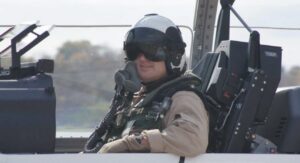
Wideman in a T-6 as an instructor in 2012.
Following the attacks on September 11, 2001, Wideman’s squadron deployed from Darwin, Australia, to the coast of Pakistan to support operations in Afghanistan. Operating from the USS Peleliu (LHA), Wideman flew approximately 138 combat missions in the Harrier. The squadron spent 8 to 9 months conducting missions around the clock, 24 hours a day, without a port call for six months. Wideman described, “We would roll in on a target and drop bombs. We carried 1000-pounders, which were laser-guided bombs. When we were out of bombs, we would head back to the ship, which was about 800 miles back through Pakistan.” Wideman tried to describe what it can be like flying your first mission, saying, “You’re always in the back of your head wondering if you’re prepared to do your job, and you just don’t want to screw it up. I remember rolling up on my first target in Afghanistan and just did not want to screw it up. When you’re coming out of the sky at 550 miles an hour, it’s like up there an inch is a mile,” He explained how his main focus was not to miss your target, and “dropping it on a friendly.”
When he wasn’t flying, Wideman explained, “You eat, sleep, and work out. I was in the best shape of my life; I hit the gym three times a day because there was nothing else to do.” He mentioned that they would occasionally have a “steel beach picnic” with music, which was a gathering or party on the flight deck. He laughed and recalled, “Every 45 days, though, you get two beers, so that was cool.” Wideman also described how hot and crowded it was on the ship, especially when they traveled close to the equator.
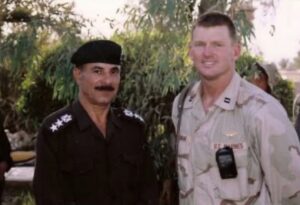
Wideman, right, after hiring his first Iraqi counterpart while working as police chief of Adwaniya in 2003.
In 2003, Wideman left Yuma and reported to Camp Pendleton, where he was assigned to the 3rd Battalion, 5th Marines as a Forward Air Controller (FAC). Just two weeks after arriving, his unit deployed for the invasion of Iraq. During the operation, they secured the Rumaila oil fields and moved toward the northeast corner of Baghdad.
During that deployment, Wideman took on an unexpected role. He was appointed police chief of Adwaniya, a city of roughly 500,000 people located about 300 miles southwest of Baghdad. With no prior law enforcement experience, he secured a building to serve as a police station, hired a local Iraqi police chief, and helped establish a police academy. Using seized AK-47 rifles, they trained local recruits and worked to build a functioning police force. When asked about the differences between a ground tour and an air tour, Wideman said the biggest thing is the unknowns, explaining, “It was kind of crazy. You know, you’re going to get shot at at some point, but you can’t really prepare for that. And it’s just, you know, how will I react under pressure? How will I do my job?” The ground deployment lasted about eight months, with the full deployment lasting just under a year.
After returning from Iraq, Wideman moved into an instructor role in Kingsville, Texas, where he taught in the T-45 training program with Training Squadron VT-22, focusing on the weapons phase of pilot training. After two and a half years, he was given orders for an unaccompanied ground tour overseas in Japan. Since he was married at the time, he decided to apply to the Naval Postgraduate School in Monterey, California. He had to move quickly to avoid heading to Japan and was able to put his packet together in four days. There, he earned a graduate degree in acquisition and finance.
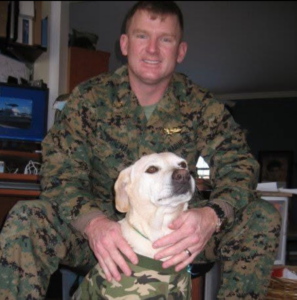
Wideman with his dog, Niña.
Following graduate school, Wideman completed a payback tour at Quantico, Virginia, serving as a budget analyst and cost estimator for command and control and communications programs. Later, due to a shortage of instructor pilots in the Marine Corps, he returned to flying and accepted a tour in Pensacola, Florida. There, he instructed in the T-6 Texan II with Training Squadron VT-6 and led the Fixed Wing Instructor Training Unit (FITU) for approximately two years.
After 25 years of combined service in the Army and Marine Corps, Wideman retired as a Major in August 2014, officially concluding his military career in January 2015.
His transition to civilian life came quickly. In August 2014, he interviewed with United Airlines and began training just two months later. Wideman initially flew the Airbus A320 before transitioning to the Boeing 757 and 767 fleets. Since 2018, he has served as an instructor for those aircraft at United’s training center in Denver, Colorado.
Outside of aviation, Wideman maintains a strong connection to the outdoors. He enjoys skiing and hiking in Colorado and anything outdoors. After losing his brother to cancer in 2018, he stated, “I realized life is short.” In 2020, he purchased a cattle farm in Missouri with no original plans to live there full-time. But after a great offer on his condo at the Lake of the Ozarks, he moved to the farm.
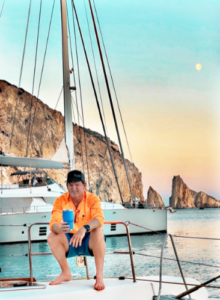
Wideman, 2025, on his catamaran in Greece.
Wideman has also developed a passion for sailing after buying a small sailing kayak while living at the lake. He admits, ” I bought the American Sailing Association 101 book, I would go read it, and then I would go out and try to do it. I had no idea how to do any of it, and I just thought it was cool. So, I went and took lessons and got my certification from the American Sailing Association.”
After earning certification through the American Sailing Association, he purchased a catamaran in 2021 and placed it into a charter program. The charter contract runs through April 2027, after which he plans to begin semi-retirement and spend more time sailing, likely keeping the boat somewhere along the East Coast to make it easier to cruise to the Bahamas.
Reflecting on his time in uniform, Wideman says he thoroughly enjoyed his career in the Marine Corps and valued the opportunity to serve as an officer and train as a pilot. When asked what guides him today, it is the leadership lessons he learned while serving. Wideman states, “The leadership skills in general are something that will never leave you, but also being able to deal with what civilians would call high stress situations that you know aren’t really that bad.” The best way he knows how to manage high-stress situations is to compartmentalize challenges and focus on priorities.
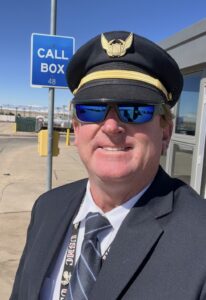
Wideman, working as a pilot for United Airlines.
As Wideman describes it, the key is to identify “the snake that’s going to bite you first”—and address it before moving on to the next problem. That mindset, developed over decades of service, continues to shape how he approaches everything, whether it’s in aviation, running a cattle farm, or sailing a fifty-foot catamaran.
After 25 years of service in two branches of the armed forces, Major Jeff Wideman’s career reflects dedication, adaptability, and leadership—from being an Army enlisted high schooler, to flying combat missions, training future pilots, and leading Marines around the world.
Veterans Care Coordination is proud to recognize Jeff Wideman for his service to our country. We are privileged to have the opportunity to share the stories of our nation’s heroes. Thank you for your service, Jeff.
