
VA Pension, Disability Compensation & Community Care | VCC
VA Benefits: Pension, Disability Compensation, and Community Care
When a Veteran or family member begins looking for help with care, the conversation often starts with a simple question:
“What VA benefits are available to help?”
The answer isn’t always simple. The VA has several programs that can help Veterans, but they serve very different purposes. Some provide monthly financial benefits, while others provide health care through VA or an authorized community provider.
Understanding the difference between VA Pension with Aid & Attendance, Disability Compensation, and the Community Care Network (CCN) can help Veterans, families, caregivers, and the professionals who support them better understand their options.
VA Pension with Aid & Attendance
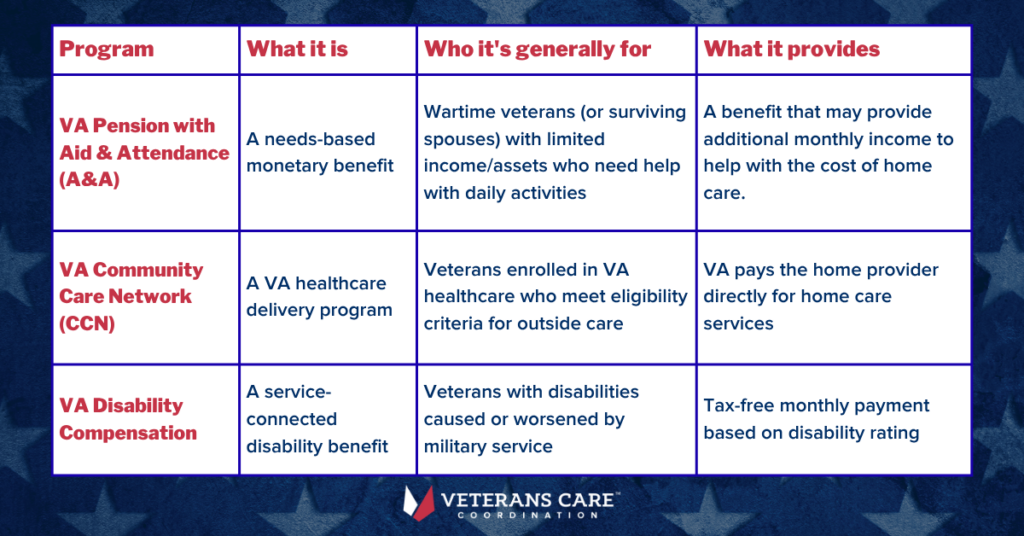
A needs-based benefit that can help with the cost of care
VA Pension is a needs-based benefit for qualifying wartime Veterans and certain surviving spouses. VA considers factors such as income, net worth, age, and disability when determining whether someone qualifies for pension. The disability does not have to be related to military service.
Aid & Attendance (A&A) is an increased pension benefit for someone who qualifies for VA Pension and also meets additional requirements based on their need for assistance.
For example, a person may qualify for Aid & Attendance if they need regular help from another person with activities of daily living such as bathing, dressing, feeding, or other personal functions. Other circumstances can also qualify, including certain severe visual impairments, being bedridden, regular supervision or protection from the hazards and dangers of your daily environment due to cognitive decline, memory issues, or mental health conditions, or residing in a nursing home because of loss of mental or physical abilities.
What does the money pay for?
Pension with Aid & Attendance is paid to the Veteran or surviving spouse. It is not a payment made directly by VA to a home care agency.
The recipient can use the benefit to provide additional monthly income to help with the cost of home care.
Think of it as:
Pension + Aid & Attendance = financial assistance for a qualifying Veteran or survivor with financial need and qualifying care needs.
VA Disability Compensation
Compensation for a service-connected disability
Disability Compensation is different from Pension.
It is a tax-free monthly benefit for Veterans with disabilities connected to or aggravated by military service. Unlike Pension, it is not based on income or net worth. The amount is primarily determined by the Veteran’s VA disability rating and other applicable circumstances.
A Veteran could receive Disability Compensation for conditions such as a service-connected injury, illness, or other disability.
The important thing to remember is:
Disability Compensation is based on a service-connected disability—not financial need.
A Veteran receiving Disability Compensation may choose to use that monthly payment toward whatever expenses they have, including home care. However, receiving Disability Compensation does not automatically mean VA will pay a home care provider directly.
That is an important distinction between Disability Compensation and Community Care.
VA Community Care Network
Healthcare provided outside of a VA facility
The Community Care Network (CCN) is part of the VA health care system and allows eligible Veterans to receive VA-authorized health care from community providers when applicable requirements are met. The CCN is VA’s primary contracted network of community providers used to help deliver this care.
Depending on the Veteran’s needs, eligibility, and VA authorization, Community Care may include services such as:
- Home health and home-based care
- Rehabilitation and therapy
- Skilled nursing and certain nursing home care
- Hospice and palliative care
- Respite care
- Other healthcare services authorized by VA
VA home and community-based services may include homemaker/home health aide services, skilled home health care, respite care, hospice and palliative care, and other supportive services, depending on the Veteran’s clinical needs and the services VA authorizes. Receiving Disability Compensation does not automatically qualify a Veteran for Community Care.
The key difference
CCN is not a monthly cash benefit.
Instead, VA authorizes specific healthcare services and pays for authorized care delivered by participating community providers.
For most non-urgent and non-emergency community care, VA authorization is required before care is provided.
Think of it as:
The VA’s Community Care = VA-authorized healthcare delivered by a community provider.
Can Veterans Receive More Than One of These Benefits?
This is where things can get confusing.
Pension and Disability Compensation
No. A Veteran cannot receive VA Pension and VA Disability Compensation at the same time.
If someone qualifies for both, VA pays the benefit that provides the greater amount.
It’s essential to understand that Veterans with a disability rating can still be eligible for Pension. However, the VA does not provide both benefits simultaneously. If a Veteran qualifies for both, the VA will usually award the higher benefit amount, in accordance with its policies. This ensures that Veterans receive the maximum support available to them.
Community Care + a VA Financial Benefit
Yes, these can generally exist at the same time because they serve different purposes.
For example, a Veteran could receive a monthly VA financial benefit and separately receive VA-authorized healthcare through Community Care if the Veteran meets the requirements for both programs and the care is authorized.
One does not automatically qualify someone for the other.
One important distinction: Aid & Attendance can mean different things
The term “Aid & Attendance” can sometimes cause confusion because it is used in different VA benefit contexts.
Pension with Aid & Attendance is an increased pension benefit for qualifying Veterans and survivors.
There is also Special Monthly Compensation (SMC), which can provide additional compensation to certain Veterans with qualifying service-connected disabilities and circumstances, including a need for Aid & Attendance. SMC is part of the disability compensation system and is different from Pension with Aid & Attendance.
So when someone says:
“They have Aid & Attendance.”
It’s worth asking which VA benefit they mean.
A Simple Way to Remember the Difference
Think about the purpose of each program:
Pension with Aid & Attendance
“I have financial need and need help with daily activities.”
→ A needs-based financial benefit.
Disability Compensation
“I have a disability connected to my military service.”
→ A service-connected monthly benefit.
Community Care Network
“VA has authorized me to receive healthcare in my community.”
→ VA-authorized healthcare delivered outside a VA facility.
What Should a Veteran or Family Member Do Next?
If you’re helping a Veteran or aging parent explore VA benefits, start by identifying what they already receive and what kind of help they need.
Consider these questions:
- Are they receiving a monthly payment from VA?
Find out what the benefit is called. Don’t assume every VA payment is Pension or Aid & Attendance. - Do they have a VA disability rating?
A disability rating may indicate that Disability Compensation is involved, but the rating alone doesn’t tell you what other benefits may be available. - Are they enrolled in VA healthcare?
Healthcare benefits operate differently from monthly financial benefits. - Has their VA healthcare team discussed Community Care?
Community care generally requires VA authorization before non-urgent or non-emergency services are provided. - What kind of assistance do they need at home?
Understanding whether someone needs help with personal care, household tasks, skilled healthcare, or other services can help point the conversation in the right direction.
The Bottom Line
VA benefits aren’t one-size-fits-all.
A Veteran may have a service-connected disability, a financial need, a need for assistance at home, or a combination of circumstances. Different VA programs address different needs.
Understanding the distinction can make an otherwise confusing conversation much easier:
Pension with Aid & Attendance
Financial assistance for qualifying Veterans and survivors with financial and qualifying care needs.
Disability Compensation
Monthly compensation for service-connected disabilities.
Community Care Network
VA-authorized healthcare delivered by community providers.
And while some VA benefits can work alongside one another, not every benefit can be combined or “stacked.” Pension and Disability Compensation cannot both be paid at the same time, while Community Care is a separate healthcare program that may coexist with a VA financial benefit when the Veteran meets the applicable requirements.
The best place to start is understanding what benefit a Veteran already has, what they need, and what VA program may address that need.
A note from Veterans Care Coordination
Understanding VA benefits shouldn’t be overwhelming. Veterans Care Coordination is committed to helping Veterans, families, caregivers, and our community partners better understand the resources available to them.
VA determines benefit requirements, benefit amounts, and authorization for VA programs. This article is intended for general educational purposes and is not a determination of benefits or eligibility.
Sources
